Updated: May 2026
Larantuka vs. Labuan Bajo for an Exclusive Flores Getaway
When comparing Larantuka vs Labuan Bajo, the choice hinges on your travel philosophy. Labuan Bajo is Flores’s vibrant, well-established hub for luxury tourism and Komodo National Park access. Larantuka offers a more exclusive, culturally immersive experience, serving as a gateway to the remote and pristine Lamaholot archipelago.
- Atmosphere: Labuan Bajo is a bustling tourist center; Larantuka is a historic port city steeped in authentic tradition.
- Excursions: Labuan Bajo focuses on the famous Komodo dragons and Padar Island. Larantuka provides access to unexplored islands, active volcanoes, and traditional whaling villages.
- Luxury: Labuan Bajo offers five-star hotels and high-end liveaboards. Larantuka defines luxury through unparalleled privacy, bespoke charters, and exclusive access.
The air in Flores carries two distinct scents. In the west, it’s the briny tang of the Savu Sea mixed with the hum of diesel from a hundred phinisi schooners, a palpable energy radiating from a town built on discovery. In the east, the fragrance is of cloves and sandalwood drying under the sun, layered over centuries of history whispered from colonial-era walls. This is the essential choice facing the discerning traveler in Indonesia’s Nusa Tenggara Timur: the gateway of Labuan Bajo or the departure point of Larantuka. As an editor who has spent years charting the evolution of luxury travel across the archipelago, I can tell you this isn’t a choice between two towns, but between two entirely different journeys.
The Arrival: First Impressions of Two Flores Gateways
Your experience of Flores is defined from the moment you land. Arriving at Labuan Bajo’s Komodo International Airport (LBJ) is an exercise in modern efficiency. The terminal is new, sleek, and processes a steady stream of travelers arriving on direct 75-minute flights from Bali. The drive into town reveals a landscape in perpetual motion: new boutique hotels climbing the hillsides, dive shops with gleaming equipment, and restaurants buzzing with international patrons. This is a frontier town that has fully arrived on the global tourism stage. The harbor is a forest of masts, with over 200 registered tour vessels, from budget backpacker boats to multi-million dollar private yachts, all preparing to navigate the famed waters of Komodo National Park. It is impressive, organized, and immediately accessible. Labuan Bajo is a destination engineered for a seamless transition from airport to adventure.
Contrast this with the arrival in Larantuka. Flying into Gewayantana Airport (LKA), often via a connection in Kupang, feels like a step into a different era. The airport is modest, the pace unhurried. The town itself is not a tourist hub but a working port city, the administrative heart of the East Flores Regency. Its identity is shaped by its deep history as a Portuguese colonial outpost and a vital center for Catholicism in the region. Instead of tour agencies, the streets are lined with local markets and historic churches. The scent of the sea is mixed with incense from nearby chapels. My friend, maritime historian Dr. Alistair Finch, calls Larantuka “one of the last true port cities in Indonesia, where trade and tradition still outweigh tourism.” This initial impression is critical; it signals a journey that demands more participation, a willingness to engage with a place on its own terms, not those set by a tourism board.
Navigating the Tourist Trail vs. Forging Your Own Path
In Labuan Bajo, the path is beautifully paved. The tourism infrastructure is mature, allowing for a “plug-and-play” luxury experience. Within an hour of leaving the airport, you can be on a state-of-the-art liveaboard, cocktail in hand, cruising towards the iconic landscapes of the national park. The itinerary is a classic for a reason: the sunrise hike on Padar Island, the obligatory photo on Pink Beach, and the primeval encounter with Komodo dragons on Rinca. It is spectacular and executed with precision by numerous high-end operators. However, it is a shared experience. You will hike Padar with dozens, sometimes hundreds, of other visitors. You will anchor in bays alongside a fleet of other vessels. Before the pandemic, Komodo National Park received over 186,000 visitors in a single year, a testament to its magnetic appeal but also a factor to consider for those seeking solitude.
Larantuka, by contrast, is where the map has blank spaces. It is the launching point for expeditions, not tours. The concept of a “tourist trail” dissolves in the waters of the Solor and Alor archipelagos. Here, you charter a vessel not to join a queue, but to escape it entirely. Journeys from Larantuka, Flores, are curated, bespoke affairs designed around discovery. You might spend a day exploring the volcanic slopes of Ile Ape on Lembata, or find yourself the sole visitor to a remote weaving village on Adonara, where the ikat patterns tell ancestral stories. It’s about navigating to deserted coves, snorkeling over reefs that have yet to be named, and engaging with communities that see visitors as guests, not customers. This is active, expeditionary travel, requiring a different mindset. It replaces the comfort of a set itinerary with the thrill of genuine, unscripted exploration.
The Marine Experience: Komodo’s Crowds vs. Lamaholot’s Secrets
The underwater world west of Flores is, without question, legendary. Komodo National Park is a UNESCO World Heritage site for a reason. Dive sites like Batu Bolong, Castle Rock, and Manta Point are globally renowned for their powerful currents and staggering biomass. Here you can witness schooling sharks, squadrons of manta rays, and coral gardens teeming with life. I’ve logged dozens of dives here, and the sheer density of marine megafauna is consistently astonishing. The trade-off, however, is popularity. On any given day, you can expect to share these premier dive sites with three to five other liveaboards. The underwater experience, while phenomenal, is rarely a solitary one. The professionalism of the dive operators is high, but the sense of raw, untouched wilderness has been tempered by its own success.
East of Flores, the story changes. The Lamaholot archipelago, accessible from Larantuka, offers a marine environment that is equally rich but vastly less documented. This is the frontier of Indonesian diving. The coral health in many parts of the Alor Strait is extraordinary, with coverage exceeding 75% in some areas—a figure rarely seen in more trafficked regions. Aboard a private charter, you can explore seamounts that see only a handful of divers each year, if any. The experience is one of pure discovery. I recall a conversation with expedition leader Dr. Lawrence Blair, who described these eastern waters as “the Amazon of the oceans, with new wonders around every limestone karst.” The luxury of a marine journey from Larantuka Flores is not just about the quality of the vessel, but the quality of the silence—the profound experience of being the only boat in a pristine, vibrant ecosystem.
Cultural Immersion: A Tale of Two Histories
While Labuan Bajo is the gateway to a land of dragons, its cultural offerings often feel secondary to the main event of nature tourism. Visitors can arrange trips to nearby Manggarai villages like Melo or Cecer to witness a Caci whip-dance performance, a powerful display of local tradition. These are valuable experiences, but they are often performances scheduled and framed for an outside audience. The economic lifeblood of the town is inextricably linked to the park, and the cultural narrative naturally orients itself around supporting that industry. The focus is outward, on the islands and the sea, with the town serving as a comfortable and well-equipped basecamp for those natural pursuits. The primary story Labuan Bajo tells is one of adventure and natural wonder.
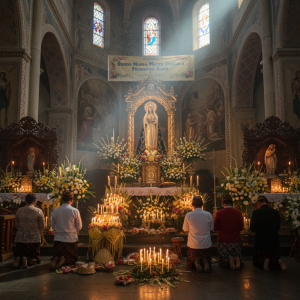
Larantuka’s story, on the other hand, is one of deep, intrinsic cultural and historical identity. This is a place where culture is not a performance but the very fabric of daily life. As one of the earliest Catholic communities in Indonesia, its Portuguese heritage, dating back to the 16th century, is palpable. The city is globally known among the faithful for its Semana Santa, or Holy Week, procession. This is not a tourist event; it is a deeply sacred and authentic pilgrimage that has taken place for over 500 years. As detailed by Indonesia’s official tourism site, indonesia.travel, it’s a profound cultural immersion. Beyond this event, exploring the region means engaging with the Lamaholot people, visiting traditional villages where life moves to an ancient rhythm, and understanding a history shaped by sandalwood trade, colonialism, and enduring faith. A journey from Larantuka is an invitation to step into a living history.
The Definition of Luxury: Five-Star Hotels vs. Unrivaled Exclusivity
Luxury in Labuan Bajo is tangible and aligns with international standards. It’s found in the infinity pool of the AYANA Komodo Resort, the impeccable service at the Sudamala Resort, or the amenities aboard a high-end phinisi charter, which can cost upwards of $20,000 a week. These vessels are floating boutique hotels, complete with air-conditioned staterooms, gourmet chefs, and curated wine lists. The service is exceptional, the comfort is absolute, and the quality is consistent with five-star expectations anywhere in the world. It is a well-understood and expertly delivered form of luxury, designed to provide a seamless and comfortable bubble from which to experience the ruggedness of the surrounding islands.
In the Larantuka sphere, luxury is redefined. It is not about thread counts or brand names; it is about access and absence. The ultimate luxury here is the absence of other travelers. It is having a mile-long, powder-white beach on a deserted island entirely to yourself for the day. It is the privilege of a private conversation with a village elder, facilitated by a guide who has spent years building trust and relationships. Luxury is a chef preparing a sashimi platter from a yellowfin tuna you caught an hour earlier, anchored in a turquoise bay where the only other sound is the call of a sea eagle. This is the luxury of space, of silence, and of unrepeatable moments. It is less about material comfort and more about the priceless commodity of true, unmediated experience. A bespoke voyage from Larantuka Flores is an investment in this rarer, more profound definition of exclusivity.
Quick FAQ: Larantuka vs Labuan Bajo
Which is better for first-time visitors to Indonesia? For a first-time visitor, Labuan Bajo’s well-developed infrastructure and clear-cut itineraries centered on Komodo National Park provide an easier and more straightforward introduction to the natural wonders of Flores. Its accessibility and range of options make it less daunting.
Which destination is more suitable for serious divers and underwater photographers? Both are world-class. Labuan Bajo offers guaranteed action at famous, high-current sites perfect for wide-angle shots of megafauna. Larantuka appeals to the explorer, offering pristine, rarely-dived reefs and the chance for genuine discovery, ideal for those who prize unique encounters over ticking off a famous site from a list.
How do the costs compare for a luxury trip? The cost for a top-tier liveaboard or resort in Labuan Bajo is well-established and comparable to other global luxury destinations. A fully-customized private charter from Larantuka can reach a similar or higher price point, but the investment is in unparalleled privacy, logistical complexity, and a highly personalized itinerary, rather than standardized five-star amenities.
What is the best time of year to visit each? The dry season, from April to November, is ideal for both destinations, offering calm seas and clear skies. However, Larantuka’s most significant cultural event, the Semana Santa procession, takes place during Easter (March or April), which can be a compelling reason to visit during the shoulder season.
The decision between Larantuka and Labuan Bajo is not a verdict on which is superior, but a reflection of your intent as a traveler. Labuan Bajo is a world-class destination, expertly packaged and delivered. Larantuka is a world-apart departure point, the beginning of a true expedition. If your goal is to see the iconic wonders of Flores in comfort and style, Labuan Bajo is an impeccable choice. But if you are drawn to the allure of the uncharted, the authentic, and the profoundly personal, then the journey eastward is the only one to take. Your expedition into the heart of the Lamaholot archipelago begins here. Explore our curated voyages and let us craft your journey from Larantuka, Flores.