Updated: May 2026
Larantuka Flores — Larantuka Good Friday Procession — Tuan Men…
Larantuka Flores is a curated Indonesia luxury tourism experience offered by Larantuka Lamaholot Voyages: handpicked routes, vetted operators, transparent pricing, and 24/7 concierge support across Indonesia.
- What makes Larantuka Flores a premium experience.
- How Larantuka Lamaholot Voyages curates exclusive access and concierge logistics.
- Routes, seasons, and pricing transparency — no hidden fees.
Good Friday in Larantuka — the harbor passage and eight armida stations.
An hour-by-hour walkthrough of the most photographed and least understood liturgical day in Asia. Read this before you fly. Labuan Bajo tourism
The lede — why Good Friday matters most
If you only attend one day of Semana Santa Larantuka, attend Good Friday. The day combines the two most distinctive Lamaholot Catholic rituals — the Tuan Meninu boat procession across the harbor in the afternoon, and the eight-station armida foot procession through the streets after dark — into a single arc that runs from morning Stations of the Cross at the Cathedral to past midnight at the eighth station. Tens of thousands of Lamaholot Catholics from across East Flores, Adonara, Solor, Lembata, and the Catholic diaspora converge on Larantuka for the day. Many have walked or sailed for days. The procession is not performed for tourists — it is the spiritual heart of a people for whom Friday before Easter is the one day in the year when the entire town’s Catholic identity becomes visible. Understanding the day’s structure is what separates a respectful pilgrim from a confused tourist.
Morning — Stations of the Cross at Reinha Rosari Cathedral
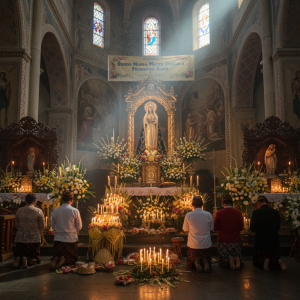
The day begins quietly. From around 8am, Lamaholot Catholics gather at Reinha Rosari Cathedral for the Stations of the Cross. The bishop and clergy lead, and the Confreria brothers in their black ceremonial dress are present in the front pews. The full Stations service runs about ninety minutes. Visitors are welcome at the rear of the Cathedral. We attend on our 5-day pilgrimage and brief beforehand on what to expect — the service is in Indonesian with Lamaholot prayer interludes. After Stations, the Cathedral remains open until lunch and pilgrims can light votive candles. The Confreria typically returns to the Tuan Ma and Tuan Ana chapels for private preparations between 11am and 2pm — these are closed to outsiders.
2pm — the Tuan Meninu boat procession across the harbor
This is the unique-to-Larantuka ritual that exists almost nowhere else in Catholic practice. Around 2pm, the Confreria brothers carry the Tuan Meninu — a small statue of the Body of Christ in a glass case — from the chapel to the Promesa pier, the historic landing point that has been used for harbor processions since the 16th century. A flotilla of fishing boats, traditionally seven but sometimes more, accompanies the central Confreria boat. The flotilla rows or motors slowly across Larantuka harbor toward Larantuka town’s main shoreline, while pilgrims along the shore kneel, pray, and chant. The candles on the boats reflect across the harbor water. The crossing takes roughly 45 minutes and culminates with the Tuan Meninu being landed at the main town pier and processed back to the chapel under candlelight. Pilgrim viewing position: the harbor shoreline north and west of the main town pier. We position our group at a designated pilgrim viewpoint with shade, water, and a clear sightline to the flotilla. Photography permitted at general viewing positions, no flash, no close-range Tuan Meninu transit photographs. Read about the broader cultural background in our Lamaholot cultural heritage briefing.
6pm — the eight armida chapel stations begin
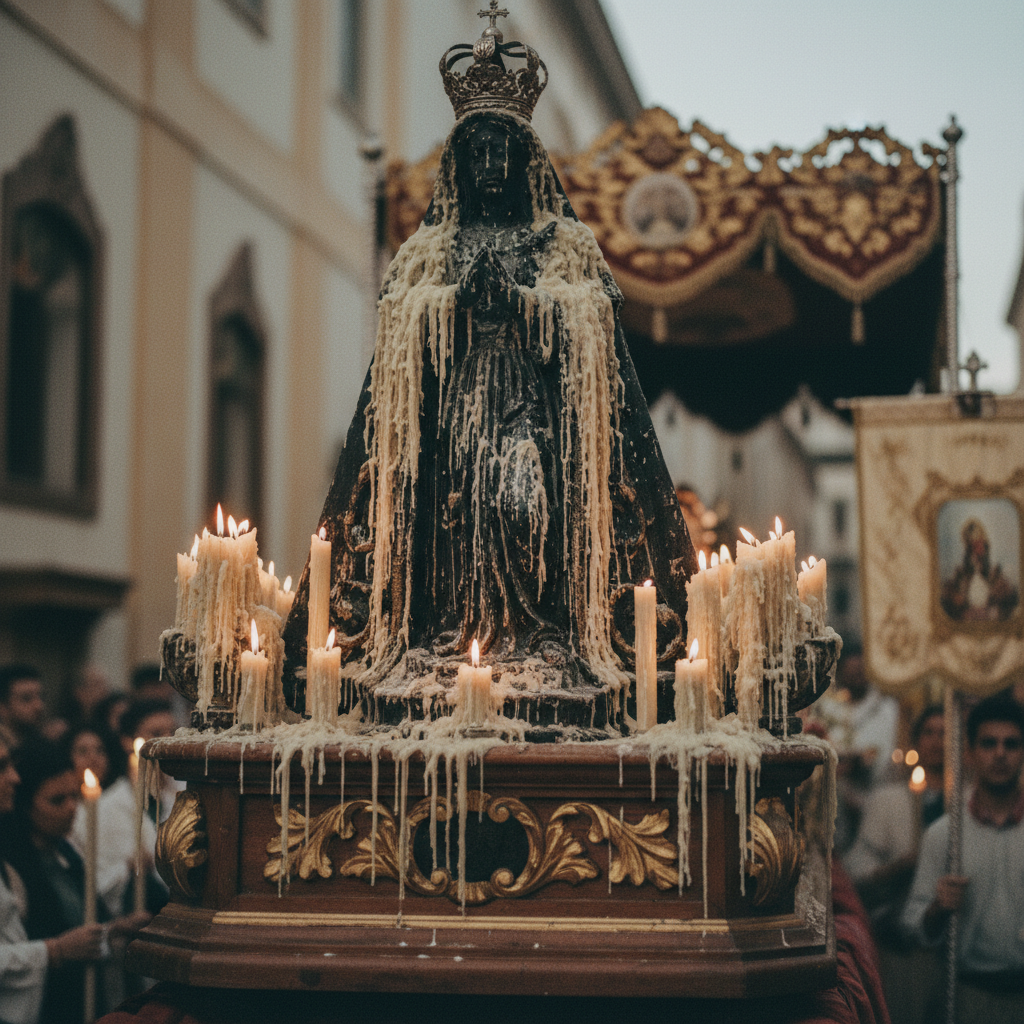
After sunset, the second Good Friday procession begins — the foot procession through eight chapel stations called armida (a Portuguese-derived word meaning fortified shelter or temporary altar). The eight armida are constructed each year by Lamaholot families and parish councils and are positioned along a roughly six-kilometer route through Larantuka town. The Confreria brothers carry the Tuan Ana statue (the figure of the dead Christ) from one armida to the next. At each station, prayers in Indonesian and Lamaholot are recited, hymns sung, and the procession pauses for roughly fifteen minutes before continuing. The full procession of all eight stations runs from approximately 6pm to past midnight. Tens of thousands of pilgrims walk all eight stations; many walk barefoot. The pace is slow. The atmosphere is one of contemplative silence broken only by hymns and the rhythm of feet on stone. Our 5-day pilgrimage walks all eight stations with the group, with rest breaks, water, and a shaded extraction option for any pilgrim who needs to leave the procession before completion.
Dress code and photography for Good Friday
Good Friday is the strictest of the four Holy Week days. Dress code: long trousers or skirts (knee-cover minimum), shoulder-covering shirts, dark colors strongly preferred — black or navy is most appreciated. White or bright colors are inappropriate. Closed walking shoes essential — you will walk between five and twelve kilometers on uneven volcanic stone. Bring a small bottle of water and a modest sun hat for the afternoon harbor procession. Photography: permitted only at designated general viewpoints. No flash photography in any context. The Tuan Meninu close-range transit is off-limits to cameras. The armida station prayer pauses may be photographed gently from the rear of the crowd; no photographs during walking. Mobile phone ringers off from 2pm through midnight. We provide a printed pilgrim card with all of this on Day 1 of our pilgrimage and re-brief each morning so the rules are second nature by Friday.
Body language during the procession
A few simple Lamaholot etiquette norms make the difference between a welcomed visitor and one perceived as intrusive. First, never block the procession path. The Confreria brothers carrying the bier walk a defined route; pilgrims line the sides. Step back when the bier approaches and bow slightly as it passes. Second, do not raise your voice during procession hours — even at viewing positions, conversation is whispered. Third, do not eat or drink openly during the procession; Lamaholot Catholics traditionally fast on Good Friday and visible eating is jarring. Fourth, if you are kneeling Lamaholot pilgrims surround you, stay standing or kneel briefly to match their posture; do not stand high above kneeling pilgrims. Fifth, when the procession enters a narrow street and you are crowded, walk to the rear of the crowd rather than push through. These norms are not policed harshly — Lamaholot people are exceptionally welcoming — but matching them is what makes you a pilgrim rather than a tourist.
Where to stay for Good Friday access
Larantuka has limited hotel capacity — approximately 600 rooms across the town. During Holy Week the entire inventory is booked, often 8-12 months in advance. The closer your accommodation is to Reinha Rosari Cathedral and the harbor, the easier your Good Friday logistics. We hold rooming blocks at three partner hotels within walking distance of the Cathedral. Independent travelers attempting Larantuka inside 90 days of Easter typically cannot find rooms in town and must commute from Maumere — a four-hour drive each way that makes the late-night armida procession impractical. Booking early, through us or independently, is the single most important logistic decision.
The Portuguese colonial origin of the Larantuka harbor procession
The Tuan Meninu boat procession is older than most other elements of Larantuka Holy Week. The custom of carrying the Body of Christ across the harbor by candlelit boat appears to date to the late 16th or early 17th century, in the first generations of Portuguese Dominican mission activity, and is sometimes traced to a sailors devotion brought from Iberian Atlantic ports. The Lamaholot fisherman families who provided boats then have continued to provide boats now — many of the fishing boats in tomorrow’s flotilla belong to families that can document continuous Confreria participation across ten or twelve generations. The Portuguese left Larantuka by 1859 when Dutch authority was established, but the procession continued. The Dutch authorities tolerated it. The Japanese during occupation did not interfere. After Indonesian independence, the procession became, paradoxically, an important marker of Larantuka’s distinctive Catholic identity within an overwhelmingly Muslim nation. Today the procession is not only protected by the Diocese of Larantuka but treated by the Indonesian Ministry of Tourism as part of the country’s recognized intangible cultural heritage.
The chants and the silence
A pilgrim arriving for the first time often does not register that the harbor procession has a soundtrack. The Confreria boats and several of the trailing fishing boats carry chanters who sing antiphonal Latin hymns — Stabat Mater, Pange Lingua, and the Lamaholot-inflected Confreria-specific dirges that have been sung at this procession for centuries. The chanters do not amplify their voices; the harbor itself acts as a natural reverberation chamber and the chants carry across the water. Pilgrims kneeling on the shore are expected to remain silent so the chants are audible. The silence is not awkward. It is one of the most striking features of the day. After the boat passes, you will hear only the water against the hulls, the rustle of the candle wax dropping into the sea, and the distant voices of the chanters fading toward the next viewpoint. Photographs cannot capture this. Memory does.
After Good Friday — what comes next
The armida procession concludes around midnight at the final station. Pilgrims rest briefly. Holy Saturday begins with the Tuan Ma and Tuan Ana joint procession late morning — Tuan Ma the black Madonna and Tuan Ana the dead Christ statue process side by side for nearly six hours through the same town and chapel route. Easter Sunday closes the cycle with Resurrection Mass at the Cathedral. The full liturgical arc takes the cultural meaning of Good Friday and transforms it — from mourning into resurrection joy across two days. To experience the full arc and not just the most photographed day, our 5-day pilgrimage is the right approach.
Read further
The Catholic Diocese of Larantuka publishes the official Holy Week program on the diocesan website a few weeks before each Easter, with timings and route map. The Wikipedia article on Semana Santa Larantuka is a useful overview with primary-source citations on the Portuguese colonial origins. Our deeper context briefing is the Tuan Ma and Tuan Ana relics history.
Walk Good Friday with our Confreria-adjacent guides
Our 5-day pilgrimage positions you correctly for harbor and foot processions. Reverent guidance, dress code briefing, photography protocol.