Updated: May 2026
Larantuka Flores — Lamaholot People — Cultural Heritage of Eas…
Larantuka Flores is a curated Indonesia luxury tourism experience offered by Larantuka Lamaholot Voyages: handpicked routes, vetted operators, transparent pricing, and 24/7 concierge support across Indonesia.
- What makes Larantuka Flores a premium experience.
- How Larantuka Lamaholot Voyages curates exclusive access and concierge logistics.
- Routes, seasons, and pricing transparency — no hidden fees.
Who the Lamaholot are — and why their syncretism is the foundation of Larantuka’s Holy Week.
A 250,000-person ethnolinguistic group across East Flores, Adonara, Solor, and Lembata. Pre-Catholic Lera Wulan worship was never abolished — it was woven into the rite.
The lede — why Lamaholot identity matters for Holy Week
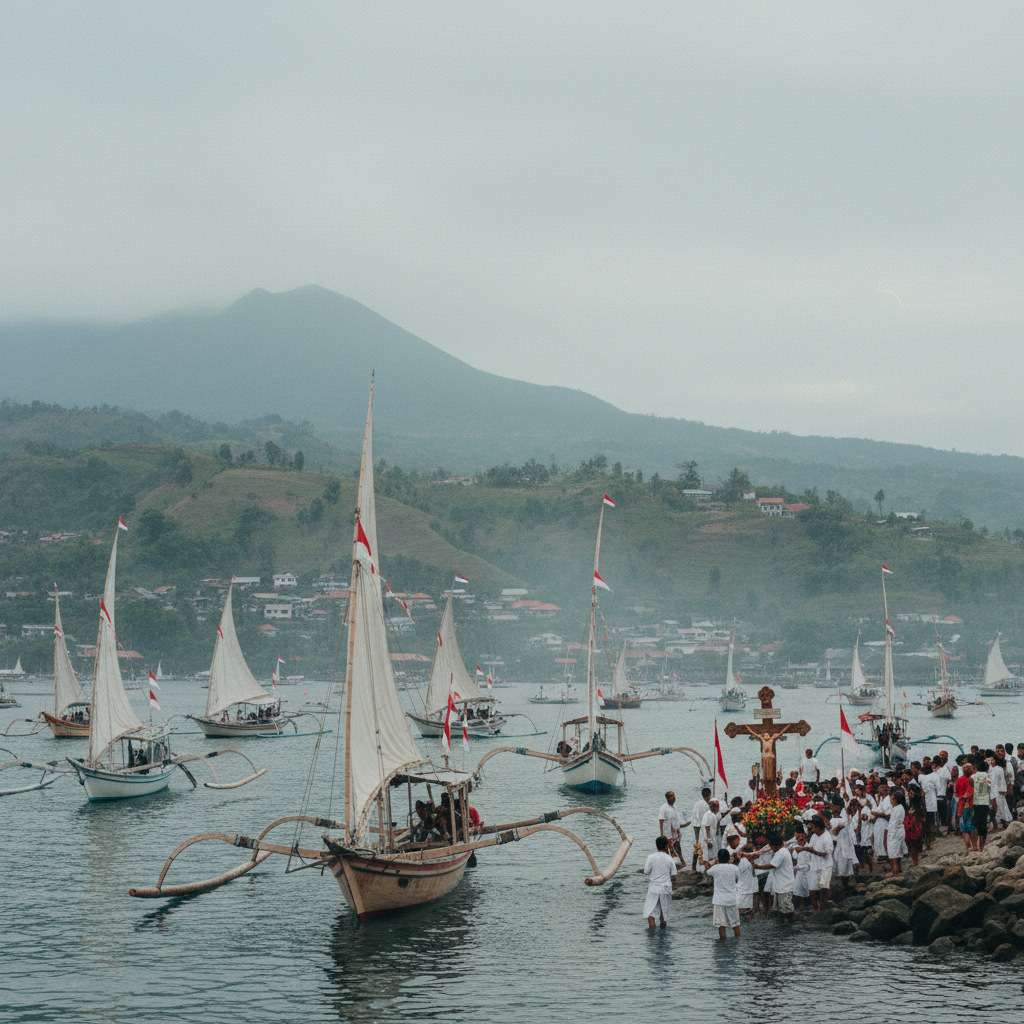
When the Portuguese reached Larantuka in 1510 and installed a Dominican mission shortly after, they did not encounter an empty island. They encountered the Lamaholot — an Austronesian ethnolinguistic group of perhaps 60,000 people at the time, organized into village federations across East Flores and the surrounding islands of Adonara, Solor, and Lembata. The Lamaholot had a sophisticated cosmology. They worshipped Lera Wulan — sun and moon — venerated ancestors at koke kakeng meeting houses, and conducted seasonal rites tied to agricultural and maritime cycles. The Portuguese mission did not attempt to abolish these practices. Instead, they accepted Lamaholot conversion to Catholicism while permitting traditional rites that did not directly contradict Catholic theology to continue. The result, five centuries later, is a syncretic practice in which Lamaholot Catholics open every chapel ceremony with offerings of betel and tuak palm wine to the ancestors before the priest’s prayer. Holy Week — Semana Santa Larantuka — sits at the apex of this syncretism. To understand why the Confreria’s procession looks the way it does, you have to understand the Lamaholot.
Geography — where the Lamaholot live
The Lamaholot region covers the eastern peninsula of Flores Island and the three smaller islands to the east — Adonara, Solor, and Lembata (formerly Lomblen) — across roughly 6,000 square kilometers. Total population is approximately 250,000. The group divides into recognizable subgroups by dialect — Lewotobi-Larantuka in the west, Adonara-Solor in the middle, Lembata-Kedang in the east — and the linguistic boundaries roughly track village federation networks. Larantuka itself sits at the western tip of the Lamaholot region, on the Flores mainland, looking out across the strait to Adonara just two kilometers away. From any high point in Larantuka you can see Adonara’s volcano, Ile Boleng, rising against the sky. The proximity matters — many Lamaholot Catholics from Adonara and Solor cross to Larantuka by small fishing boat for Holy Week, and the cultural network across the strait is closer than the distance to the next major Indonesian city. The Wikipedia article on the Lamaholot people covers the linguistic background in detail.
Lera Wulan — the pre-Catholic cosmology
Before Catholicism, Lamaholot religion centered on Lera Wulan — a compound term meaning sun (lera) and moon (wulan), conceptually understood as the highest cosmic principle that organizes time, fertility, and morality. Lera Wulan was approached through ancestor veneration rather than direct prayer. Each Lamaholot family lineage maintained a koke kakeng — a meeting house and ritual structure — where the family’s nuba nara stones were kept and where annual ceremonies tied to planting, harvest, and the maritime trade cycle were performed. Beyond ancestor work, Lamaholot ritual included tuak palm wine offerings, betel quid offerings, and ikat-cloth gift exchange to mark major life events — birth, marriage, death, and house construction. None of this was abolished by the Portuguese mission. Catholic theology of saints and Communion was overlaid on Lamaholot ancestor practice, and many Lamaholot today understand the Catholic saints as a kind of cosmic family that includes their own lineage ancestors. The koke kakeng meeting houses still stand in many Lamaholot villages and many continue to host annual rites in parallel with the parish liturgical calendar.
How syncretism actually works in practice
Visitors imagine syncretism as a kind of confused mixing — Catholic on Sunday, traditional on Tuesday. The Lamaholot reality is more refined. In practice, every major Catholic ritual in the Lamaholot region opens with a brief Lamaholot ancestor invocation. Before the Holy Week procession begins, Confreria elders make ancestral offerings at the chapels. Before a wedding Mass, the bride’s family makes ancestor offerings at the koke kakeng. Before a new chapel is consecrated, the village elders perform a Lamaholot land-blessing rite. The Catholic priest — typically a Lamaholot man trained at the Diocese of Larantuka seminary — accepts these openings as proper preparation rather than rivalry. After the ancestor rite, the Catholic Mass proceeds with Roman liturgy, in Indonesian or Latin, and concludes with both Catholic and Lamaholot blessings. This pattern is not a transitional compromise — it has been stable for five centuries and is the active form of Lamaholot Catholic identity. The Diocese of Larantuka explicitly endorses it; the diocesan website publishes annual letters from the bishop affirming the inculturated form of Larantuka Catholicism.
The Confreria Reinha Rosari — hereditary Lamaholot brotherhood
When the Portuguese mission installed itself in Larantuka, the Dominican fathers handed devotional governance to a council of Lamaholot family heads. This council took the title Confreria Reinha Rosari — Brotherhood of the Queen of the Rosary. Membership has remained hereditary along Lamaholot family lines for five centuries. You cannot apply to join. A boy is born into a Confreria-eligible family, is initiated in his teens, and serves through his life. The Confreria has its own internal hierarchy — twelve senior brothers called the Confraria Tuan, several dozen junior brothers, and a network of family heads who provide labor and resources for the annual procession. The brotherhood has never been disbanded. Through Dutch colonial rule, Japanese occupation, Indonesian independence, and every diocesan reorganization since, the Confreria has staffed Holy Week without interruption. The Catholic Church recognizes the Confreria as a lay brotherhood under the Diocese of Larantuka. The Lamaholot recognize it as a continuation of pre-Catholic family-federation governance in Catholic form. Both readings are correct. Read more in our Tuan Ma and Tuan Ana relics history briefing.
Lamaholot ikat weaving — the visual language of the culture
Beyond ritual practice, the most visible Lamaholot cultural expression is ikat weaving. Lamaholot ikat is hand-loomed cotton or silk cloth in which the warp threads are tie-dyed before weaving, producing characteristic geometric and figurative patterns in deep indigo, rust red, and natural cream. Each Lamaholot subgroup has distinctive motifs — Lewotobi clan houses, Adonara stylized whales recalling the Lamalera whale-hunting tradition, Lembata serpent and ancestor patterns. A high-quality ikat panel takes a skilled weaver three to six months to complete. Ikat is the central object of Lamaholot gift exchange — given at weddings, used to wrap the bodies of the dead, exchanged between Confreria families, and given to Catholic clergy as a sign of respect. Visitors to Larantuka can purchase ikat panels at the town market or at village weaving cooperatives; we coordinate village visits for our pilgrims who want to see the loom and meet the weaver. A panel costs IDR 800,000 to 4,000,000 depending on size and complexity.
Lamalera — the whale-hunting tradition of southern Lembata
A Lamaholot cultural feature worth mentioning, even though it is not directly part of Larantuka Holy Week, is the Lamalera whale-hunting community on the southern coast of Lembata island. Lamalera is one of the few places in the world where a small community of approximately 1,500 Catholic Lamaholot still hunts sperm whales using traditional hand-built boats called peledang and hand-thrown harpoons. The hunt is regulated by the International Whaling Commission as an indigenous subsistence whaling exception. The Lamalera season runs roughly May to October. The community is intensely Catholic — the boats are blessed each year at the parish chapel — and the whale hunt is interwoven with Lamaholot ancestor practice. Lamalera is not on most pilgrimage itineraries but can be added as a 3-day extension; we coordinate this with a partner Lembata operator on request, with full ethical briefing and cultural sensitivity protocols.
What visitors should know — and what they should leave alone
A few practical points for visitors approaching Lamaholot culture. Yes, you may visit a koke kakeng meeting house if invited; do not enter without permission. Yes, you may purchase ikat at markets and cooperatives; do not photograph weavers without consent. Yes, you may attend a Lamaholot Catholic wedding or community feast if invited; bring a small gift (modest tuak palm wine or store-bought sweets are appropriate), wear modest dress, and follow your host’s lead on seating and toasting. Do not attempt to participate in ancestor offerings unless explicitly invited. Do not photograph children’s faces without parental consent. Do not collect ritual stones or artifacts; everything has spiritual ownership. Our anthropologist guide briefs all of this on Day 1 of the pilgrimage and walks you through specific situational protocols. Lamaholot people are exceptionally welcoming to respectful visitors, and the relationships built during a 5-day pilgrimage often extend into pen-pal exchanges and return visits.
Read further
The Wikipedia article on Lamaholot people is a useful linguistic and demographic overview. The Indonesian Ministry of Tourism’s regional pages on East Nusa Tenggara cover Lamaholot heritage tourism. For the Holy Week-specific dimension, see our Good Friday harbor procession briefing.
Walk through Lamaholot heritage with our pilgrimage
Our 5-day pilgrimage includes village ikat visits, koke kakeng exterior observation, and Lamaholot host family dinners.