Updated: May 2026
Larantuka Flores — Tuan Ma and Tuan Ana — The 16th-Century Rel…
Larantuka Flores is a curated Indonesia luxury tourism experience offered by Larantuka Lamaholot Voyages: handpicked routes, vetted operators, transparent pricing, and 24/7 concierge support across Indonesia.
- What makes Larantuka Flores a premium experience.
- How Larantuka Lamaholot Voyages curates exclusive access and concierge logistics.
- Routes, seasons, and pricing transparency — no hidden fees.
Tuan Ma and Tuan Ana — the 16th-century icons that anchor five centuries of Holy Week.
The black Madonna of Larantuka and the dead Christ statue. How they arrived, where they are housed, and why the Confreria treats them as relics. Flores on Wikipedia
The lede — what these icons actually are
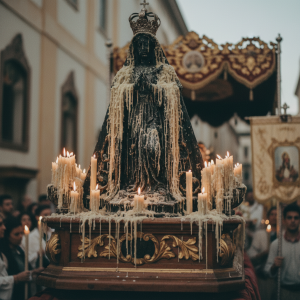
In modern Catholic practice, statues of Mary and Christ are usually understood as devotional aids — visual prompts for prayer rather than objects of veneration in themselves. In Larantuka, the two statues at the heart of Holy Week — Tuan Ma the black Madonna and Tuan Ana the figure of the dead Christ — are treated more like relics than statues. They are housed in two separate chapels (Kapela Tuan Ma and Kapela Tuan Ana) under the year-round care of the Confreria Reinha Rosari. They are dressed by Confreria brothers in scented oil and changed seasonally. They are washed annually in a private ritual called Muda Tuan that no outsider has ever witnessed. They are processed through the streets of Larantuka in glass biers that are themselves treated as sacred objects. The Catholic Diocese of Larantuka recognizes both icons as objects of legitimate devotion. The Lamaholot treat them with the reverence reserved in pre-Catholic practice for ancestral relics. Both readings coexist. Understanding the icons is the closest thing to understanding the cultural and theological core of Semana Santa Larantuka. Labuan Bajo tourism
Tuan Ma — origin tradition
Tuan Ma — literally translatable as Lord Mother in archaic Lamaholot, meaning the Mother of God or the Virgin Mary — is a wooden statue of the Virgin standing approximately 130cm tall, with darkened wood (hence the local descriptor black Madonna), dressed in deep purple velvet. Lamaholot tradition records that the statue washed ashore at Larantuka in the 16th century, found by a fisherman who recognized it as a holy object and brought it to the village elders. The elders constructed a small wooden chapel for it. The Portuguese Dominican mission, when it arrived, identified the statue as a Marian icon, recognized the village as having received a divine sign, and built the relationship that became the Confreria’s stewardship. The story is treated as historical by the Lamaholot and as legendary by academic historians; the wooden statue itself has been carbon-dated to roughly the 16th century, consistent with either Portuguese transit or independent regional carving. What is undisputed is that Tuan Ma has been continuously housed in Kapela Tuan Ma — a small chapel near Reinha Rosari Cathedral — for at least four centuries, and that the Confreria has guarded the icon without break.
Tuan Ana — the figure of the dead Christ
Tuan Ana — literally translatable as Lord Son or Lord Child — is the figure of the dead Christ at the moment of removal from the cross. The statue is wooden, approximately 160cm long, carved in the lying-down posture characteristic of Iberian-derived Christ-of-the-Sepulchre devotion. Tuan Ana is dressed in white linen and carried in a glass coffin (peti) during Holy Saturday’s procession. The icon’s origin tradition is similar to Tuan Ma’s — washed ashore in the 16th century, carried by Confreria families, housed in a separate chapel called Kapela Tuan Ana. The two icons are processed together only on Holy Saturday, when Tuan Ma in her purple velvet and Tuan Ana in his glass coffin move side by side from chapel to chapel for nearly six hours. The pairing — Mother and Son in adjacent biers — is the most visually striking moment of the entire week and is not encountered in any other Catholic Holy Week tradition globally.
The Muda Tuan ritual — annual washing and dressing
Each year on the Wednesday before Holy Week, the Confreria conducts the Muda Tuan ritual. Twelve senior brothers enter the Tuan Ma chapel before dawn. The chapel is closed to all outsiders. The brothers remove the icon’s purple velvet vestments, place the statue on a white cloth, and wash the wood with scented coconut oil and rose-water. The vestments are themselves cleaned and re-stitched annually by Lamaholot Catholic women from designated families. New flowers are arranged at the chapel altar. After the washing, the brothers re-dress the icon in fresh purple velvet, return it to its alcove, and emerge to announce that Holy Week may begin. The Muda Tuan washing has never been photographed or filmed. It has never been opened to outsiders. The Diocese of Larantuka and the Confreria are united in protecting the privacy of this ritual. Visitors arriving on Wednesday afternoon, like our 5-day pilgrimage, will find the chapel exterior visible but will not enter; we explain what occurred and what it means as the cultural lead-in to the four liturgical days that follow.
Kapela Tuan Ma and Kapela Tuan Ana — the chapels
Both chapels are modest one-room wooden structures with stucco exteriors painted in the Larantuka tradition — white walls, blue trim, Portuguese-derived tile floor. Kapela Tuan Ma sits two blocks east of Reinha Rosari Cathedral. Kapela Tuan Ana sits three blocks south. Both are visible from the main town square but neither is open to the public except during the procession days when the icons are temporarily moved to the Cathedral. Year-round, the chapels are maintained by Confreria families on a rotation system — one family per quarter undertakes daily cleaning, flower arranging, and small repairs. Photography of the chapel exteriors is permitted at any time. Photography of the chapel interiors is not — even on the few days each year when interiors are briefly visible, the Confreria asks for no cameras. We respect this on every pilgrimage and explain why on Day 1 of the briefing.
Visitor protocols at the chapels
A few simple rules. Do not attempt to enter the chapels at any time without explicit Confreria invitation — and Confreria invitations to outsiders are, in practice, exceedingly rare. The exteriors may be approached respectfully; if you wish to leave a flower offering at the chapel door, our guides explain how to do this with correct posture (the offering goes on the chapel step, not pushed through the door). Photography of the exterior is welcome; do not photograph the door itself or the small windows. If you encounter a Confreria brother in his black ceremonial dress entering or leaving the chapel, step aside and bow slightly; do not attempt conversation, as he may be in a liturgical state. The chapels are sacred property of the Lamaholot Catholic community in a way that genuinely matters; visitors who treat them as such are universally welcomed; visitors who approach them as photo backdrops are not. We brief all of this on Day 1 of the pilgrimage. Read more about the cultural framework in our Lamaholot cultural heritage briefing.
The biers and procession infrastructure
Beyond the icons themselves, the procession infrastructure includes the glass biers (sometimes called peti for Tuan Ana, with the term reserved for the coffin-style enclosure), the candle stands, the umbrella canopies that shield the icons during outdoor transit, and the chant books used by the Confreria in their ceremonial dress. Each item has dedicated stewardship — one family is responsible for the Tuan Ana glass coffin; another for the Tuan Ma umbrella; another for candle replenishment. This distributed system is one of the reasons the procession has run without interruption for five centuries — no single point of failure exists. If a particular family is unavailable in a given year, a deputy from a related family steps in. The Confreria’s organizational design is, in some ways, a study in resilient ritual continuity, and is the subject of growing academic interest from anthropologists at Universitas Indonesia and Universitas Flores.
After the procession — what happens to the icons in the off-season
Following Easter Sunday Mass, the icons are returned to their respective chapels in a quiet closing ritual on Easter Monday. The biers are cleaned and stored. The candle stands are inventoried. The Confreria conducts an annual general meeting in the weeks following Easter to discuss the year’s procession and any logistic improvements. The chapels return to their year-round caretaking rhythm. In May, the rains return to East Flores and Larantuka becomes quiet again. The icons rest in their alcoves until the following Holy Week. For visitors, the off-season offers a rare opportunity to walk the procession route in peace, see the chapel exteriors without crowds, and visit the Reinha Rosari Cathedral with time. The icons themselves are not visible in the off-season — they remain inside the closed chapels — but the cultural presence of Tuan Ma and Tuan Ana is felt throughout Larantuka year-round.
Read further
For deeper academic context on the inculturation of Catholicism in eastern Indonesia, see the publications of the Diocese of Larantuka on the diocesan website. The Wikipedia article on Semana Santa Larantuka covers the historical timeline. Our companion piece is the Good Friday procession briefing.
Witness Tuan Ma and Tuan Ana with our pilgrimage
Our 5-day pilgrimage positions you correctly for Maundy Thursday torchlight and Holy Saturday joint procession. Reverent guidance, chapel-exterior briefings, full protocol training.